Tuesday, April 13, 2010

Book Review: The Jane Austen Book Club


The Jane Austen Book Club, written by Karen Joy Fowler, brings together 5 ladies -- and one guy -- who all get together to read and discuss Austen's six novels. The book is half an analysis of these novels, and half a character study of the book club members.

Jocelyn and Sylvia have been buddies since high school, and even dated the same guy, Daniel, who Sylvia ended up marrying. Now the women are in their fifties, and Sylvia and Daniel are divorcing. Sylvia's 30-year-old daughter Allegra is also in the book club; she went through a recent breakup with her girlfriend. Prudie, a 28-year-old French teacher, doesn't understand why her wonderful husband Dean loves her so much, and she has to come to grips with her relationship with her mother after she dies. Bernadette is in her sixties, has been married three times and is quite eccentric -- she's been known to go to the grocery store in slippers with her hair sticking up. And Grigg is a 40-something "mystery man" to the woman. All they know is that he's a science fiction geek who decides to join the club after meeting Jocelyn at a convention.

The book is broken up into months, and in each month, the club explores a different Austen novel. Along with that, each month gives an in-depth look at one of this book's characters. Sometimes what happens in the month parallels a theme or part of an Austen book. For example, when the club is studying Pride and Prejudice, there is a scene somewhat similar to the ball the Bennett sisters attend in P&P. I found this very clever on Fowler's part.

However, the characters seemed really two-dimensional to me. For example, I didn't see the point in Fowler letting us know that Jocelyn dated Daniel first; it never comes into play in the novel. Prudie's mother dying also doesn't seem to make much of a difference on her character developement. And even more bizarre is why Grigg suddenly starts to have a crush on the older, never married, dog-raising Jocelyn. There is no real chemistry between the two earlier in the book that leads you to believe they might pair up.

The Jane Austen Book Club (which was made into a movie in 2007 starring Emily Blunt) is a quick, easy read fun for any Austen fan. But I'm not sure what the great writer herself would think of this book.

Book Review: I Don't Care About Your Band


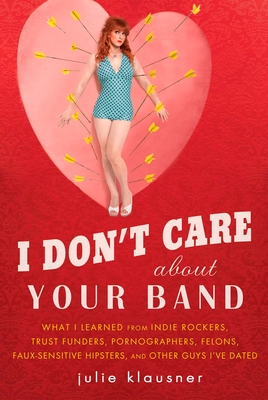
In the vein of Chelsea Handler, comedy writer and performer Julie Klausner's I Don't Care About Your Band is a hilarious guide to all the weirdos and losers Klausner has dated -- and what she's learned from it.

There was her obsession with an actor who played Sweeney Todd on Broadway. Her time in her teenage years spent calling a "special hotline." Noah, the younger guy whose bed had a surprise treat in store for Klausner -- bedbugs! And Rob, the guy who was a Star Wars fanatic and gave her herpes. All fun times.

Besides laughing at her past mistakes in the dating pool, Klausner riffs on how Kermit was so not into Miss Piggy (right on!) and how a meet-up with a male pen pal 20 years later was like a scene in Fargo (the one where Marge meets up with her high school friend at a Radisson hotel in Minnesota -- Klausner and her pen pal even met up at the same hotel). She also subtly gives dating advice and pretty much says it's OK to make dumb choices and go out with the wrong types of guys -- as long as you learn from your mistakes and figure out what's acceptable to you and what's not.

Book Review: Running with Scissors


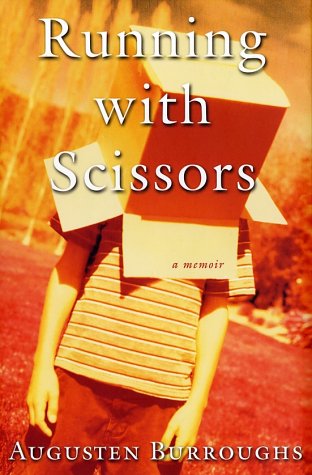
Augusten Burroughs' memoir Running with Scissors can on one page make you laugh out loud, and on the next completely horrify you.

The book, originally published in 2002 (and later adapted into a movie), goes back to the time when Burroughs was a 12-year-old kid with a crazy mom and a withdrawn father. After his parents separate, Burroughs' mother decides to leave him with her eccentric psychiatrist, Dr. Finch, and his houseful of wacky relatives.

Dr. Finch is a character all by himself. He claims to has a "masturbatorium" in his office and, in one hilarious chapter, sees his poops as a sign from God (nope, I'm not making this up). Along with Dr. Finch is his long-suffering wife Agnes, 28-year-old live-in daughter Hope (who does a "Bible dip" to tell her fortune) and 13-year-old wild girl Natalie, a person Burroughs becomes very close to. Other children, both real and adopted, filter in and out of the house, along with other live-in patients. For years, Burroughs goes back and forth between living with the Finches and living with his mother and her girlfriend.

Some parts of Burroughs' book, such as the feces indecent and Burroughs and Natalie's attempt to create a skylight in the kitchen, are amusing. Others, like Hope trying to mercy kill her cat and Burroughs' mother letting a mental patient live with them, are a little crazy. And even beyond that, the stories of Burroughs being encouraged by his mother and Dr. Finch to "fake suicide" so he can spend some time in a psychiatric ward just so he doesn't have to go to school, and his sexual relationship with Dr. Finch's 33-year-old adopted son, are downright horrifying. It's clear that, no matter where he was living, Burroughs had virtually no adult supervision and was allowed to live however he wanted.

Growing up completely different than the vast majority of other teenagers, Burroughs has quite the gripping story to tell. Although he changed the names of those involved, he was later sued by the doctor's family, who claimed his story was exaggerated and embellished. Burroughs stands by what he wrote. His book is one that seems too crazy to have been fabricated -- how do you make stuff like this up?

Movie Review: Date Night


If you're looking for a hilarious movie from two of sitcom's brightest stars... you might want to skip Date Night. It's not that Tina Fey and Steve Carell don't shine in Shawn Levy's film -- they do -- it's just that this movie doesn't have the right comedic material for them.

Carell and Fey star as Phil and Claire Foster, a mediocre couple from New Jersey who have the regular middle class life -- go to work, come home, deal with the kids, go to bed. Get up the next morning and do the whole thing over again.

After hearing about their friend's impending divorce, Phil decides to shake things up. Instead of their regular date night at a local tavern eating potato skins, he wants to take Claire to an upscale restaurant in Manhattan. When they can't get a seat at the uber trendy restaurant, Phil decides they should take the table of the Tripplehorn party, who aren't there to get their table.

When the Fosters are mistaken for the Tripplehorns, they find out that this other couple is in some big trouble with a local crime boss -- and now they are in that trouble, too.

Full of hijinks and some slapstick comedy, not many scenes are as funny as they could have been. Levy had Fey and Carell in his hands, and it seems he didn't give them enough to work with. Besides an amusing scene where the couple has to strip in a club, and another where their car gets connected to a taxi, there aren't too many laugh out loud moments.

The beginning of the movie shows Fey and Carell at their local date spot, making up stories (and voices) for the couples eating around them. This is when I saw these two actors really in their element--or, at least, how I'm used to seeing them--goofing off and having fun. However, their characters aren't Liz Lemon and Michael Scott; they are a suburban couple trying to rev up their marriage. Even though they weren't as funny as I would have hoped, Fey and Carell effortlessly portray this loving albeit bored couple.

There are tons of cameos in this movie, including Leighton Meester as the babysitter; Ray Liotta as the crime boss; Mark Wahlberg as Claire's hot, shirtless former client; and Kristen Wiig and Mark Ruffalo as the divorcing couple. But by far my favorites were James Franco and Mila Kunis as the real Tripplehorns.

Overall, Date Night is a cute movie, but it won't leave you laughing and wanting more.

Monday, April 12, 2010

Book Review: Unmasked: The Final Years of Michael Jackson


I, like many people, have had somewhat of a fascination with Michael Jackson, probably considered the greatest pop artist of all time. He was a person who was so talented yet so, well, eccentric (to put it lightly) and made many people wonder what was going through his head. And with his sudden and mysterious death in June 2009, the fascination continues to grow for many people--including me.

When I noticed this book, Unmasked: The Final Years of Michael Jackson, I was intrigued but also in a way put off. The book's author, investigative journalist and blogger Ian Halperin, recently released a book about Brangelina. He also wrote another book called Who Killed Kurt Cobain?, questioning if Cobain actually committed suicide. Other books include Celine Dion: Behind the Fairytale and Fire and Rain: The James Taylor Story (what dirt is there to dig up about that guy?). I was a little concerned I would be reading a 270-page issue of the National Enquirer.

But I found the book to be both balanced and well researched. Halperin spoke with close Jackson friends Macaulay Culkin and Liza Minnelli (although the later was while he was "undercover"). He even briefly spoke with Jackson, again undercover, and he believes Jackson was flirting with him during their conversation.

Halperin starts off his book saying when he decided to write it, he believed Jackson was a child molester and that he was guilty of all the accusations. However, when he did his research, he found many people, including top entertainment journalists, who agreed, but no one could present any concrete evidence to back up their claims.

Halperin's coverage of Jackson starts in 1993, when he was first accused of child molestation. Halperin gives great detail about the legal implications, the media coverage (including the harsh coverage of the TV show Hard Copy, that frequently paid its sources), etc. Halperin even mentions that the young accuser was under sodium amytal, a barbiturate that puts people into a hypnotic state, at the time of his confession. Halperin asserts it was given to his boy by his dentist father. Halperin also details how the prosecution had to examine and photograph Jackson's body to see if it matched up with how the boy described it; it turns out it mostly didn't. There's even a full transcript of the interview with the boy at the end of the book.

The book also covers his marriages to Lisa Marie Presley (who Halperin believes married Jackson to help convert him to Scientology and "cure" his alleged homosexuality) and Debbie Rowe. It also focuses on journalist Martin Bashir's documentary on the King of Pop, right before the 2005 accusations and trial. Halperin shares details of the trial that helped me see why the jury found him innocent; apparently the family of the boy in question had tried to get money from numerous celebrities and had been involved in previous lawsuits.

Additionally, Halperin describes Jackson's body image (questioning how many plastic surgeries he had and if he bleaches his skin white) and declining health. From the information Halperin got from his sources, he predicted on his blog in December 2008 that Jackson only had 6 months to live. There was a huge backlash, but it turned out, Halperin was right. Sources told him how frightened Jackson was of his 2009 concerts in London and how he told his daughter Paris not to be mad at him if he didn't make it to Father's Day. Halperin also asserted how people in Jackson's camp enabled the pop singer's drug habit by giving him what he wanted instead of stopping it.

I think Halperin did an excellent job of being unbiased throughout the book: he presents the facts, not leaning toward the picture of a completely innocent pop star or one of a monstrous child molester. He does believe, like I do, that Michael had a strange connection with children. Maybe the King of Pop was stuck in the childhood stage because he never got to have one; Jackson also told Bashir he was abused by his father.

We may never know the truth behind many Michael Jackson mysteries, but Halperin tries to help readers make up their minds about how they feel about him.

Sunday, January 17, 2010

Book Review: How to Get Divorced by 30


When I first received this book, I thought, "Huh. What is this? Is this an advice book on how to get divorced?"

But once I started flipping through the pages, I realized How to Get Divorced By 30: My Misguided Attempt at a Starter Marriage, written by Sascha Rothchild, was a memoir.

The book starts with Rothchild approaching her 30th birthday and realizing she didn't want Jeff, her husband of 2 and a half years, at her party. Then Rothchild takes us back to her relationships before Jeff, what went wrong with those, when she met Jeff, how their relationship started out, when they decided to get married, and how Rothchild eventually decided to get divorced.

Rothchild, a TV producer and freelance writer for many newspapers and blogs, is so insightful about both her self and her significant others in all her relationships. Her unfortunately too late hindsight on her relationships may help the people reading her book. She walks the reader through her relationship and shows them the warning signs she missed. For example, she went to a lingerie party at the Playboy Mansion with another guy while she was dating Jeff, and he didn't seem to care. She also had to buy her own engagement ring, and could never get Jeff off of his La-Z-Boy recliner and away from his pot.

Rothchild's style of writing reminds me a lot of Chelsea Handler's, so if you like Handler's books, you'll love How to Get Divorced by 30. Besides rehashing her relationships, Rothchild lets us in on her wild child past (she started doing cocaine at age 13 and was dating a 19-year-old drug dealer at the time), and her kooky mother Susan (who doesn't allow her child to call her any form of "mom") who advised Rothchild, "Snort it if you must, but never inject heroin."

I'd be interested to see what a happily married twentysomething thinks of this book. As a single gal, I appreciated Rothchild's analysis of her relationships and marriage, and I think it showed me even more to be aware of the signs of a relationship that just won't work. I think it'd also be a helpful read of guys and girls who are thinking about taking the plunge.

Disclaimer: I received a complimentary advanced review copy of this book from the publisher.

Saturday, November 14, 2009

Book Review: Remember the Time


My mom always used to say she knew exactly where she was when she found out JFK died. I feel our generation already has two of those "moments": knowing where we were when we found out about 9/11 and where we were when we found out Michael Jackson died.

I had been driving home from work when I got text messages from two friends. I was really in disbelief and told them both that until I heard it from a reputable news source I wouldn't believe it. But when I got home and turned on the TV, there was the news on CNN, NBC, Fox News: Michael Jackson had died.

Most of my MJ memories consist of dancing to the Dangerous album with my little sister. My family had just gotten a CD player, and that was one of the only CDs my dad had. Emily and I would bop around to "Jam," "In the Closet" and "Who Is It" before dinner.

Others have many, many more memories of Michael, some of them personal. This includes Theresa J. Gonsalves, a writerwho shares her memories of Michael in her new book "Remember the Time."

Gonsalves is the muse for one of MJ's most well-known songs "Billie Jean," but she starts her story before the King of Pop penned that tune after her. Gonsalves was a schoolgirl in love with the Jackson 5, specifically Michael. She wrote hundreds of letters to the pop star, and made a decision she was going to fly out and see the singer perform with his brothers in Las Vegas for her 16th birthday.

It's amazing how easily the young Gonsalves got in contact with Michael. She called the hotel she knew they were staying at and asked to speak to the road manager, Randy Wiggins. She asked Wiggins if she could meet Michael when she flew out to Vegas, and Wiggins arranged for her to spend an entire week with the family.

Gonsalves and Michael bonded during her trip, and they started to talk on the phone -- all the while, Gonsalves continued to write Michael letters, something he really looked forward to receiving. They continued their friendship through Michael's solo success, with Gonsalves visiting him while he lived in New York with his sister La Toya to film The Wiz. During this time, Michael and Gonsalves started a more intimate relationship.

Gonsalves eventually moved out to California to be closer to Michael. Over the years, Gonsalves stopped writing as many letters, and just as Michael was slowly pulling away from his family, the same happened with his relationship with Gonsalves.

Through it all, Gonsalves told Michael she would always be there for him, and she kept running into him over the years, the final time being in 2003 in Las Vegas.

Through her recollections of her memories with the pop star and excerpts from her letters to them, Gonsalves sews together the special bond she shared with someone she saw as the man she loved, Michael, and not mega pop star Michael Jackson. Gonsalves showed she was more than just a groupie to the King of Pop; their relationship went much deeper than that.

Gonsalves also gives an interesting glimpse at the other Jackson family members, especially Katherine Jackson, who was kind to Gonsalves and showed her around California; a very bubbly and talkative Janet; and the religious La Toya. Gonsalves' one interaction with father Joe Jackson is memorable as well.

Included is a letter from La Toya to Gonsalves and a bunch of pictures of Gonsalves with Michael. Through reading "Remember the Time," people can get a feel for the Michael Gonsalves got to know: a kind man who loved his music and giving back to others.